
Guide to Bridal Lace

Lately I've been having more bridal inquiries than usual, and lots of these ladies are asking for lace.
With the intention of familiarizing my current and future clients with the most popular bridal laces, I'm putting together a short picture glossary along with some images of gowns made from them.
Alencon
(uh LEN sahn)
The distinguishing feature of this lace is the fine cording that is applied to the outlines of the motif. Although still delicate, this fabric has more body and structure than something like chantilly.
 |
| Credit |
 |
| Alencon example by Jim Hjelm |
Brussels Lace
Very delicate elaborate lace, often lots of raised work like what you see in the centers of the flowers. You don't see this much on modern gowns--it is very old fashioned.
 |
| Credit |
 |
| Credit |
 |
| Credit |
Chantilly
A very fine airy lace, usually with lots of detail and elaborate motifs. Like Alencon, Chantilly often (although not always) has a cord outlining the motifs, but it is much more delicate. This lace pairs quite nicely with other airy fabrics like tulle, chiffon, and georgette. It is my personal favorite out of all the laces.
 |
| Credit |
 |
| Credit |

 |
| Both chantilly examples are by Rosa Clara |
Duchesse Lace
Duchesse is supposedly the cheaper version of Brussels lace, but I can't always tell the difference to tell you the truth. The joins are of cruder constructon or something like that. It has lots of open space, as opposed to the tighter net background of chantilly and alencon.
Kate Middleton kept popping up when I was looking for gown examples. But I think that's because she is a duchess, not because her gown had duchesse lace.

 |
| Credit |

Eyelet
Not considered a "true" lace because it is worked on a fabric background, eyelet is typically made from cotton. Best suited to casual outdoor weddings, it is also a popular choice for flower girl dresses.


Guipure Lace also called Venise Lace
(Gee pee oor...I think...)
*Edit* according to my friend, it is pronounced guy-pure
(Gee pee oor...I think...)
*Edit* according to my friend, it is pronounced guy-pure
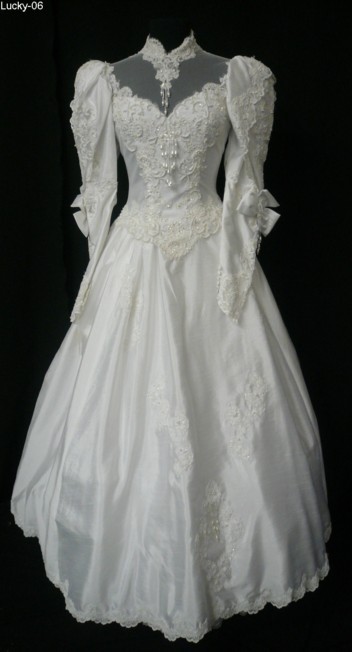
Guipure is much heavier and more textural than the other laces and as such is often used on gowns for winter weddings. Often called Venise lace (no, I did not misspell that although I have seen it spelled Venice too), there is no net or mesh background. It comes in a huge variety of designs and motifs and is also popular as appliques instead of fabric.

 |


There are some gorgeous examples of gowns that use venise lace, but if you don't watch out...
Hey girl, 1982 called and wants her dress back.
Schiffli Lace
(SHIF uh lee)
Lace pattern is embroidered onto a net backing fabric. The patterns in the other laces are created when the lace itself is created. It is particularly nice as an overlay fabric on top of tulle. There is some ambiguity when it comes to schiffli lace--the term is used in several different ways. It is often referred to as tulle lace or organza lace because these are almost always the backing fabrics.
Additionally, if you google schiffli lace, you will see lots of references to something called chemical lace, and you will see photos of what looks like venise lace. Chemical lace is created by embroidering with one type of fiber onto a fabric of another type of fiber. Then the fabric background is chemically disolved leaving only the embroidery behind.
Additionally, if you google schiffli lace, you will see lots of references to something called chemical lace, and you will see photos of what looks like venise lace. Chemical lace is created by embroidering with one type of fiber onto a fabric of another type of fiber. Then the fabric background is chemically disolved leaving only the embroidery behind.


I thought that Kate Middleton's gown was schiffli. It certainly has that look from a distance. But according to Wikipedia the bodice design was created by stitching lace appliques onto the netting.
"The lace bodice design was handmade using a technique that originated in Ireland in the 1820s called Carrickmacross, which involved cutting out rose detailing (symbolising England), thistles (Scotland), daffodils (Wales), and shamrocks (Ireland), individually applying them to the ivory silk tulle." --Wikipedia

There are of course, dozens more types of lace. These are just the basics of bridal lace vocabulary.
You might also want to have a look at my post on Bridal Necklines.
You might also want to have a look at my post on Bridal Necklines.


me encantan todos, maravillosos
ReplyDeleteWhere can I buy these laces
ReplyDeleteThank you so very much for sharing your research on lace. This is invaluable information that I have used again and again.
ReplyDeleteBest wishes to you.
Thank you so much for this great presentation!
ReplyDeletePlease would you mind helping me out. I am trying to price out for insurance purposes (lost in a landslide) some Brussels lace (per metre) that was used in my wedding gown 30 years ago when I had it made and having no joy as everyone here tells me it is now only a couture fabric. It was a roses motif that heavily covered the lower third of the cloth with roses lightly covering the remainder (completed on silk tulle). I also lost some heavy soft moss green lace that was sold to me as coming from Brussels, but is in fact a guipure lace (15 years old). Where would I go to find genuine replacement costs for these items? I would be grateful if someone could assist me. The closest thing I can find is embroidered lace on tulle in respect of the Brussels lace, but it is not silk. All I know about the guipure is that it is a genuine European lace and supposedly from Brussels (it was sold to me be a well respected bridal and silk shop). Thank you in advance for your help
ReplyDeletenice post
ReplyDeleteI wanted to thank you for this excellent read!! I definitely loved every little bit of it. I have you bookmarked your site to check out the new stuff you post. bridal dress fabrics
ReplyDeleteIs Venise Lace (or Venice) pronounced ven-iss or va-niece? I always thought it was the first, like the city of Venice but I've heard it pronounced the second way. Does anyone know which is correct? Or do both work.
ReplyDeleteAbout Venice lace I would like to specify that in the venetian lagoon there are two types of lace: Burano needle lace, and Pellestrina bobbin lace.
ReplyDeleteBurano needle lace is the most expensive because it requires a lot of time to be made and a lot of different points to create different textures and effeects, and lacemakers need decades of experience to master the technique. It has various designs because it evolved a lot through the centuries, so you can have works that when compared look very different.
Pellestrina lace, a type of bobbin lace, is often ignored, but it is beautiful and elegant too, and the most skilled lacemakers can work with an insane amount of bobbins.
Italy in general has many cities and areas where lace is made. All of them are unique and are the result of centuries of traditions and skills fiercely kept alive, but nowadays there are fewer people that study and learn them